Why study Communication at MC?

The vehicles for communication may be ever-evolving, but writing remains at the core. As a Writing/Communication major at Maryville College, you will master methodologies in creative and professional writing. You will learn how to communicate effectively to different audiences in journalism, public relations and business and technical writing. In creative writing classes – fiction, poetry and creative nonfiction – you will be challenged to realize the potential of your work through workshops, multiple drafts and intensive study of craft. The major balances instruction and practical experience, ensuring that you graduate with a substantial portfolio of original work produced through coursework, internships and participation in campus publications. You’ll be prepared for success in a variety of fields, including print and broadcast journalism, new media, publishing, corporate communications, public relations, technical writing, law, marketing, advertising and business.

ON CAMPUS OPPORTUNITIES

Student staff members of The Highland Echo publish a 10-page campus newspaper every other week during the semester. Impressions, an annual publication and bimonthly online literary magazine, features artwork, creative writing and poetry submitted by MC students.

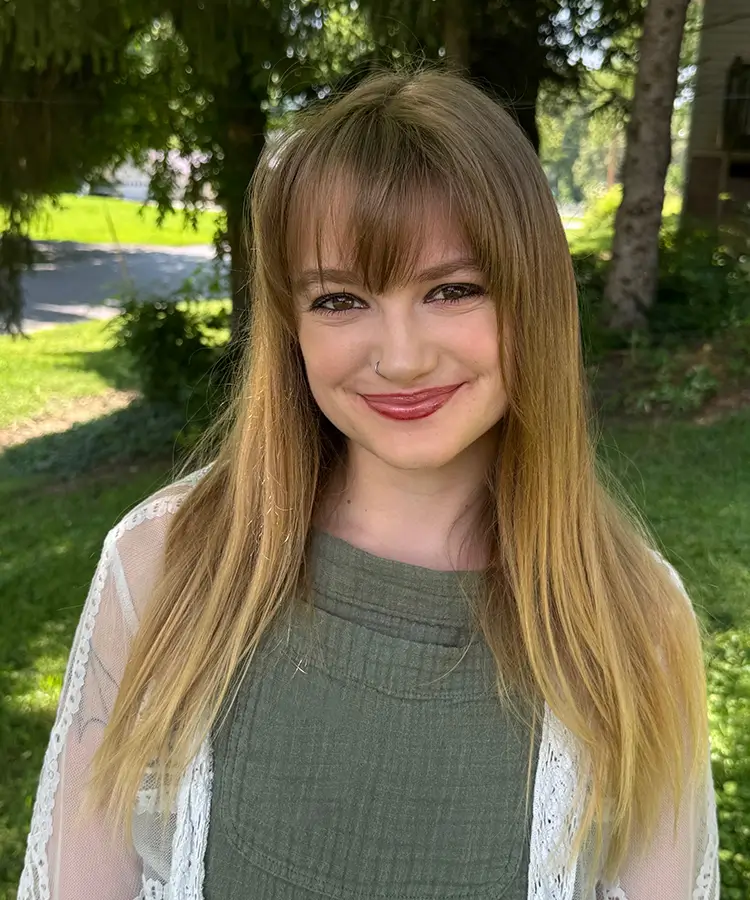
Photo of McKenna Marr

McKenna Marr

Hometown: Jonesborough, Tennessee

McKenna chose MC for its personalized learning structure and the Maryville College Works program, which offers opportunities and internships that prepare students for future careers. She also stated: “The professors are truly here to support and an encourage you into being the best student you can be.”

As a Writing Communication major, McKenna loves the creativity and freedom it gives her, to pursue minors in Theatre and Gender and Women’s Studies. As a staff member for The Highland Echo and Impressions, McKenna has gained experience in fiction and journalistic writing, the latter being the field she wants to pursue. A class assignment in an MC writing course led to publication of McKenna’s short story, “The Little Girl I Play Cards With,” in the University of Connecticut’s literary and arts magazine.


Photo of alumni David Peter who recently graduated with a degree in Writing Communication.

David Peters ’19

Currently: Pursuing a Ph.D. in Media at Syracuse University’s S.I. Newhouse School of Public Communications in New York

David began his journey at MC as a non-degree seeking student, but after one semester he found that the Writing Communication major was a good fit, so he enrolled full-time. “Honestly,” David said, “that decision changed my life for the better.”

In addition to pursuing his Ph.D., David is a manager of the Extended Reality Lab at S.I. Newhouse and is enrolled in Syracuse University’s Future Professoriate Program. His graduate study focus is in media psychology, studying media effects at both individual and societal levels.

David is thankful for his growth through the rigorous coursework and thesis requirements at MC. “I’m not sure another institution would have equipped me so adequately to deal with the pressures of a highly demanding Ph.D. Program,” he said.


 

Chair, Division of Languages & Literature, Professor of English
Dr. Will Phillips
Chair, Division of Languages & Literature, Professor of English
More Info
Associate Professor in Writing Communication
Christina Seymour
Associate Professor in Writing Communication
More Info
Associate Professor of English
Scott Steele
Associate Professor of English
More Info
Senior Lecturer in Composition
Jan Taylor
Senior Lecturer in Composition
More Info

Journalism (print and web based newspapers/magazines), public relations, writing for non-profit organizations, grant writing, television and radio broadcasting, editing and publishing, film and television production. This major also prepares the student for graduate study in communications and for law school.

The American Red Cross
The Daily Times
DENSO
East Tennessee Historical Society
Great Smoky Mountains Heritage Center
Knoxville News Sentinel
Knoxville Zoo
Mary Beth West Communications
New Hope Children’s Advocacy Center
Discovery Networks
United Way of Blount County
WUOT

Students successfully completing the program of study will have achieved:

Knowledge

  • Familiarity with major authors and works from all the major periods of Western literature, including contemporary literary writers and their works
  • Knowledge of Western literary history and the continuity of its traditions
  • Familiarity with genres/schools of poetry and prose
  • Knowledge of literary terminology
  • Knowledge of methods and strategies for generating ideas in order to produce texts of clarity that are appropriate to audience, context and purpose
  • Knowledge of writing and editing applications in non-academic contexts such as through internship experiences
  • Knowledge of methodologies for critiquing and giving constructive feedback on manuscripts
  • Knowledge of methodologies of different rhetorical situations, different modes of writing in journalism, public relations, business and technical writing
  • Knowledge about best practices, ethical and professional issues in journalism, public relations, business and technical writing

Skills

  • Ability to read with discernment—to analyze and interpret form, structure and style in expository writing and in various genres of literature
  • Ability to write with clarity, conciseness, appropriate organization, and a level of usage and style suitable for the audience and rhetorical situation
  • Ability to carry out independent research
  • Ability to show confident and articulate oral expression
  • Proficiency in copy editing and proofreading of work other than one’s own, including knowledge of various style guides and the distinction between grammar and style (AP style, MLA, etc.)
  • Ability to collaborate responsibly and efficiently within small groups or teams and within larger organizational structures to produce written reports, multimedia presentations and creative projects


The Major in Writing Communication consists of 47 hours, including 45 hours in English and 2 hours in Humanities. Transfer students bringing 45 or more credit hours in transfer are exempted from HUM 299, with the result that the major requirement is reduced to 46 hours.

Required courses include:

Major and Major-Related Courses

ENG 216: Publications (1 hrs)
ENG 216: Publications - a 1-credit hour course that is to be taken in 3 different semesters (1 hrs)
ENG 217: Journalism (3 hrs)
HUM 299: Issues in Professional Development (1 hrs)
HUM 347: Research in the Humanities (1 hrs)
ENG 351: Senior Study I (3 hrs)
ENG 352: Senior Study II (3 hrs)
ENG 399: Writing Communication Capstone (3 hrs)

One of the following (3 hrs.):

ENG 201: Advanced Literary Interpretation (3 hrs)
ENG 311: History of the English Language (3 hrs)

Two courses from the following list (6 hrs.):

ENG 213: Creative Writing: Poetry (3 hrs)
ENG 214: Creative Writing: Fiction (3 hrs)
ENG 219: Advanced Rhetoric and Grammar (3 hrs)

Two courses from the following list (6 hrs.):

ENG 313: Advanced Creative Writing: Poetry (3 hrs)
ENG 314: Creative Nonfiction (3 hrs)
ENG 315: Business and Technical Writing (3 hrs)
ENG 316: Advanced Creative Writing: Fiction (3 hrs)
ENG 317: Public Relations Writing and Practice (3 hrs)
ENG 349: Selected Topics in English (1-4 hrs)
ENG 349 may count for the Writing Communications major if it is a course in creative writing or professional writing.

Two courses in English literature at the 190 level or higher (6 hrs.):

ENG 191: American Literature: Puritan through Romantic (3 hrs)
ENG 196: Survey of British Literature I (3 hrs)
ENG 211: Young Adult Literature (3 hrs)
ENG 212: Children's Literature (3 hrs)
ENG 292: American Literature: Realism to the Present (3 hrs)
ENG 297: Survey of British Literature II (3 hrs)
ENG 322: Advanced Studies in American Literature (3 hrs)
ENG 333: English Literature of the 17th Century (3 hrs)
ENG 334: English Literature of the Restoration and 18th Century (3 hrs)
ENG 335: English Literature of the 19th Century (3 hrs)
ENG 336: British and American Literature of the 20th Century (3 hrs)
ENG 19X/ENG 2XX/ENG 3XX: Literature

One of the following combinations for a total of 9 hours:

ENG 337 (9 hours)
Or
ENG 337 (6 hours)
And
1 ENG course numbered 190 or higher
Or
ENG 337 (3 hours)
And
2 ENG courses numbered 190 or higher

All writing communication majors are strongly encouraged to minor in an area that will give them a degree of expertise in a field other than English.


The Minor in Writing Communication requires 15 hours in writing courses.

Required courses include:

Minor and Minor-Related Courses

ENG 216: Publications (3 hrs required)

Four courses chosen from the following list (12 hrs.)

ENG 213: Creative Writing: Poetry (3 hrs)
ENG 214: Creative Writing: Fiction (3 hrs)
ENG 217: Journalism (3 hrs)
ENG 219: Advanced Rhetoric and Grammar (3 hrs)
ENG 313: Advanced Creative Writing: Poetry (3 hrs)
ENG 314: Creative Nonfiction (3 hrs)
ENG 315: Business and Technical Writing (3 hrs)
ENG 316: Advanced Creative Writing: Fiction (3 hrs)
ENG 317: Public Relations Writing and Practice (3 hrs)

In addition to required courses for majors and minors, Maryville College students take classes in the Maryville Curriculum, a core program of general education. Consisting of 51 credit hours, the Maryville Curriculum ensures that students see their major in a wider context and develop the basic communication, quantitative, and critical thinking skills that are needed for success in college and career.

You may also be interested in:

Apply

Request Info

Interested in this Program of Study at Maryville College? Submit your basic information and an Admissions counselor will contact you shortly to answer any questions you might have.

Loading…